




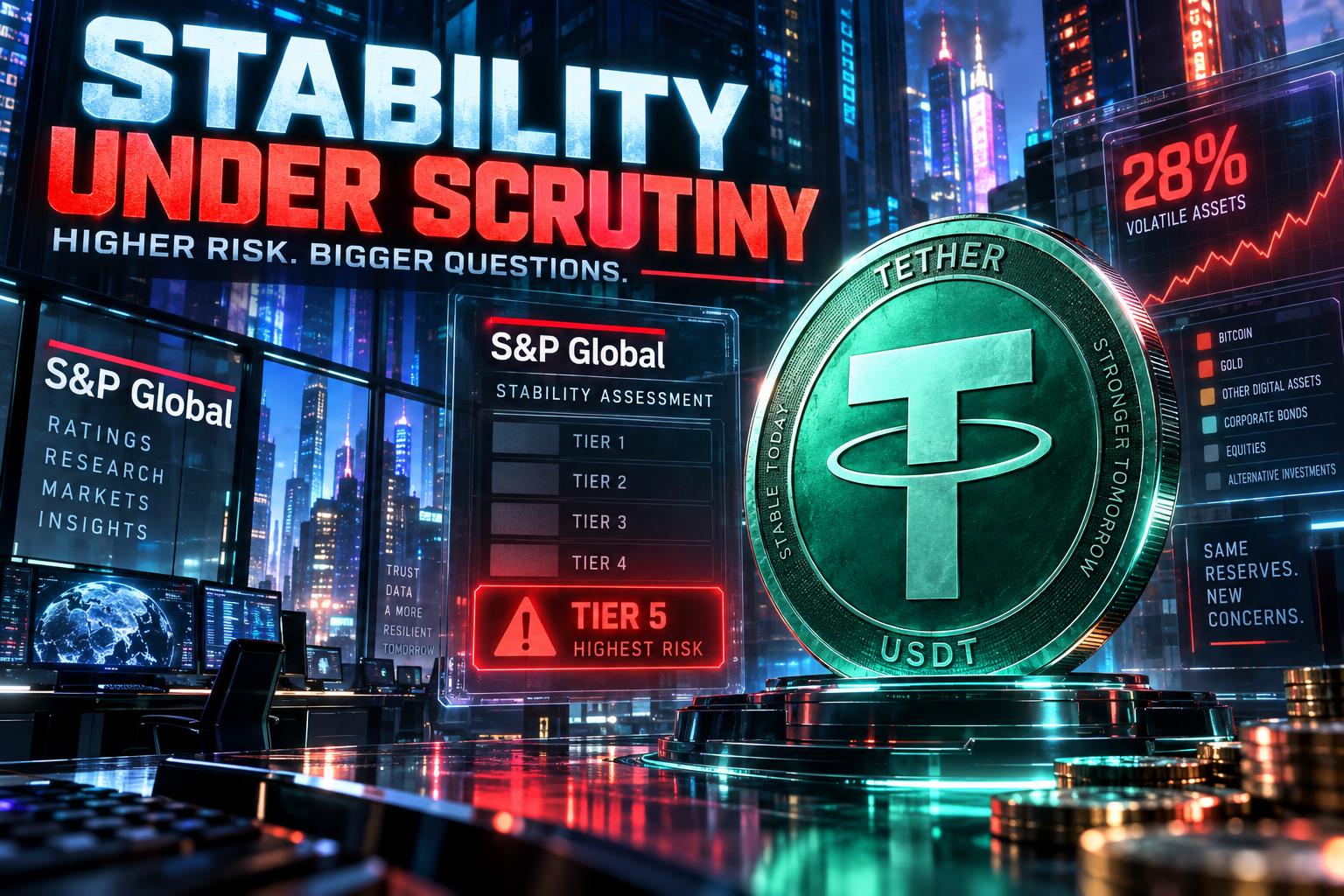

S&P Global Ratings has kept Tether’s USDt at a score of 5 (weak), the bottom of its stablecoin stability scale, pointing to an increasing share of volatile holdings backing the token and limited transparency in its legal structure.
The evaluation, published in an assessment report on Nov. 18, leaves the stablecoin’s peg stability grade unchanged from November 2025. S&P stated that while it identified further structural weaknesses in the issuer’s balance sheet and operational setup, it made no downward adjustment “because our assessment cannot be lower than 5.”
Rising Exposure to Non-Treasury Collateral
At the center of S&P’s critique is the composition of the pool defending USDt’s dollar peg. Higher-risk assets, a bucket that includes Bitcoin, gold, corporate bonds, secured loans, and public equities, climbed to represent 28% of circulating USDt as of Sept. 30. That figure stood at 24% twelve months earlier.
“A significant drop in the value of these assets could lead to USDT being undercollateralized,” S&P wrote in the evaluation.
Tether’s balance sheet data as of Sept. 30, attested by accounting firm BDO, listed roughly $191.5 billion in total reserve assets matched against $183.5 billion in liabilities. The resulting buffer of approximately $7.95 billion in excess assets has not dispelled the rating agency’s reservations regarding sudden market shocks affecting non-cash reserves.
Regulatory Scrutiny in El Salvador
S&P also highlighted vulnerabilities stemming from Tether’s regulatory base. The stablecoin issuer shifted its domicile to El Salvador in January 2025, placing its operations under the oversight of the country’s National Commission of Digital Assets (CNAD).
Under CNAD rules, Tether is required to hold 70% of its reserves in assets that can be converted to cash within 30 days. S&P viewed this mandate as permissive, pointing out that the classification encompasses volatile components like Bitcoin, physical gold, and commercial loans.
Furthermore, the agency noted that Salvadoran regulations do not mandate the segregation of reserve assets from Tether’s operational capital, diverging from the frameworks applied in the European Union and the United States. Without public disclosures confirming legal ring-fencing, S&P noted there is no visibility into how these reserve pools would be insulated from broader company liabilities during financial distress.
Disclosure Gaps and Audit Visibility
Transparency practices continue to separate Tether from its primary competitors. While rival issuers typically publish monthly breakdowns and disclose the banking institutions holding their reserves, Tether continues to release figures on a quarterly cadence without revealing its custodians or trading counterparties.
Tether secured an unqualified opinion from KPMG on its 2025 financial accounts in August 2026, which the company cited as validation of its balance sheet reporting. However, S&P pointed out that neither the detailed auditor report nor the full audited financial statements have been released publicly, preventing external parties from independently reviewing the verification process.
The rating agency’s stance has previously drawn direct pushback from Tether management. Following the original 2025 assessment, Tether CEO Paolo Ardoino wrote on X, “we wear your loathing with pride,” arguing that previous failures within traditional finance demonstrated the flaws of legacy institutions.
Despite assigning Tether its lowest stability score, S&P noted at the end of the update that USDt has maintained an unbroken track record of price stability throughout the past 12 months.