





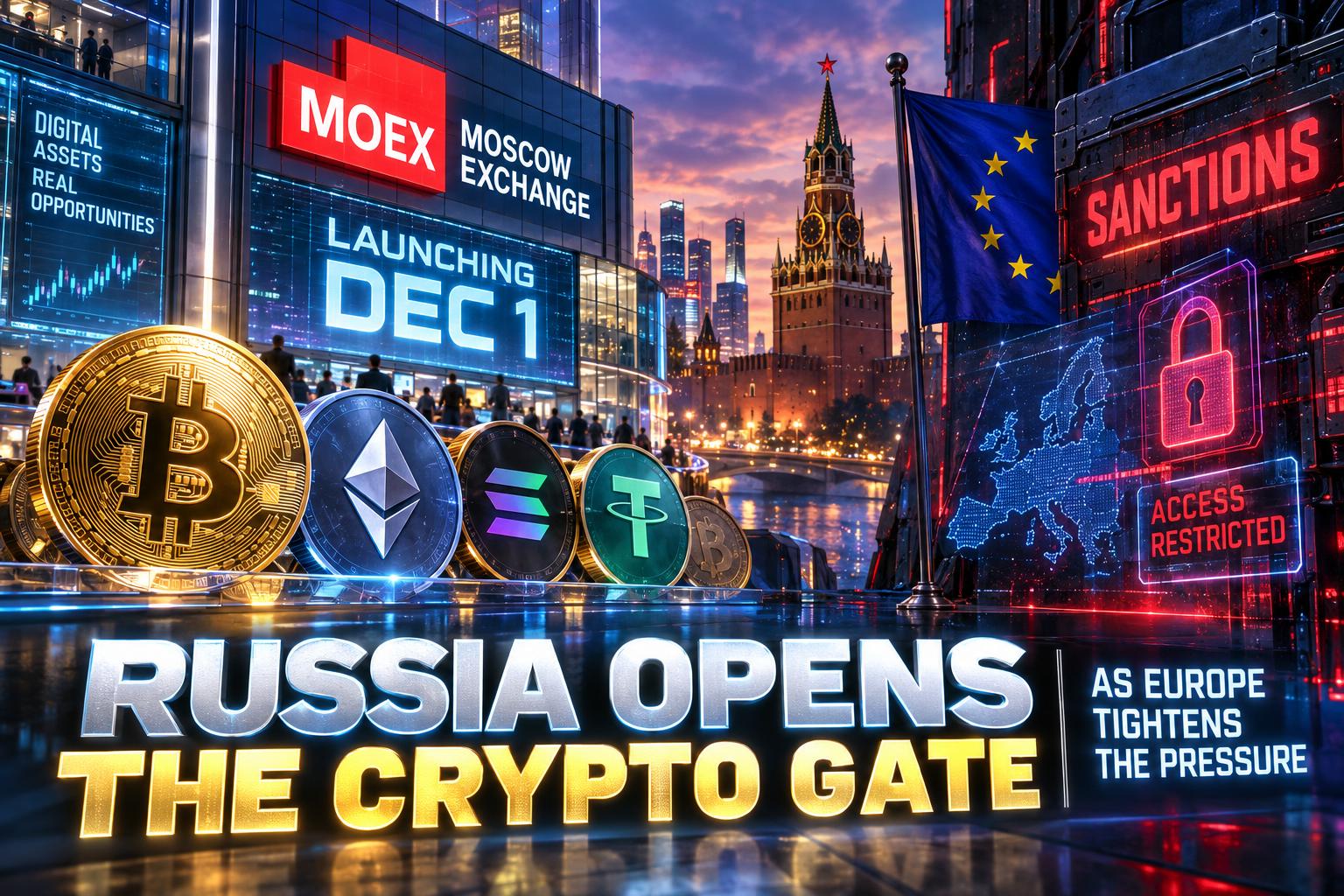

Russia launched its regulated retail cryptocurrency framework on Monday, permitting individual investors to trade Bitcoin (BTC), Ether (ETH), and Tether (USDT) through a roster of domestic institutions that the Bank of Russia listed as 30 authorized exchange operators by Wednesday. The regulatory rollout arrives just days ahead of a planned Dec. 1 launch by Moscow Exchange (MOEX), even as prospective market participants face exposure to fresh Western restrictions.
Public Disclosure and Sanctions Exposure
The primary friction point surrounding the rollout stems from the transparency of the central bank’s supervisory regime. Market participants had lobbied the Bank of Russia to keep the licensing registry confidential, seeking to shield registered financial intermediaries from being identified and targeted by foreign enforcement agencies. The central bank dismissed those requests, maintaining that crypto platforms must adhere to identical public disclosure standards as conventional banks and brokerages.
That visibility carries immediate operational risk. In Brussels, the European Union prepares its 22nd sanctions package against Moscow, with member states drafting measures specifically targeting digital asset platforms handling Russian capital. The European Commission plans to introduce the sanctions package prior to the European Council summit on Nov. 26-27, directly preceding MOEX’s scheduled market debut.
The central bank’s published directory includes state-backed banking titans Sberbank and VTB. Inclusion on the register, however, does not yet translate to operational retail services.
Broker-Routed Access and Technical Bottlenecks
While MOEX serves as the central clearing venue for the upcoming Dec. 1 integration, individual retail traders will not plug directly into the exchange engine. Instead, orders will route through registered third-party brokerages acting as clearing intermediaries.
Actual access across the approved roster remains limited. Participating desks are still assembling the requisite infrastructure to handle custodial segregation, transaction settlement, execution routing, and mandatory investor suitability testing. As of this week, none of the registered entities have opened fully functional consumer-facing trading desks for digital assets.
The institutional framework attempts to bring order to an active but contracting domestic market. Russian cryptocurrency transaction volume fell 14.7% to $284.1 billion during the twelve-month period ending in June 2026, according to Chainalysis estimates. Despite that contraction, the country continues to generate roughly 44% of all crypto transaction volume across Eastern Europe.
Russian President Vladimir Putin said at the Asia-Pacific Economic Cooperation summit in Shenzhen on Wednesday that Western sanctions had failed to derail Russian commerce and had instead strengthened domestic capacity. For Russian financial institutions moving onto the central bank’s public crypto ledger, however, the imminent European measures will test how insulated these newly regulated venues can remain from secondary sanctions enforcement.