




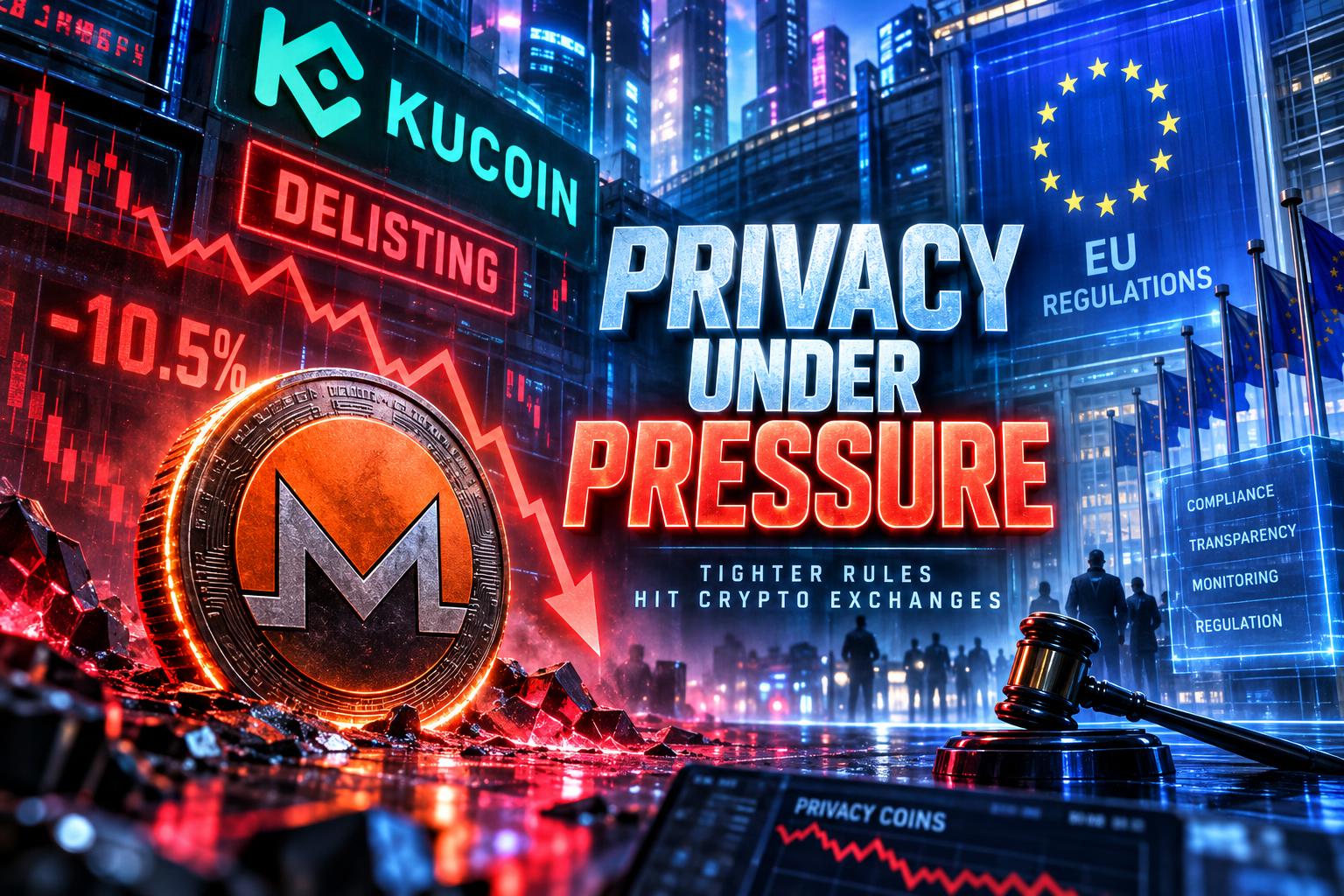

KuCoin said on Thursday it will delist Monero (XMR) on Nov. 30, making it the second major exchange this month to cut support for the privacy coin. XMR fell 10.5% to $449.98 as of 7:00 p.m. UTC on Thursday, extending a decline from roughly $625 on Nov. 3.
The exchange has already halted XMR deposits and plans to close withdrawals on Dec. 31. KuCoin’s move follows a decision earlier in November by MEXC, which suspended XMR spot trading and removed its perpetual futures contracts.
Both exits come as exchanges prepare for European Union anti-money laundering rules taking effect on July 10, 2027. Under the EU’s Anti-Money Laundering Regulation, financial firms, including crypto asset service providers, will be barred from maintaining anonymous accounts or accounts that obscure transfers through “anonymity-enhancing coins,” whether a token’s privacy features apply by default or are turned on optionally. Individuals will still be permitted to hold privacy coins in self-custody wallets.
Regulatory pressure on anonymity-focused cryptocurrencies has built steadily over the past eight years. Japan’s Financial Services Agency pressed domestic exchanges to drop privacy coins in 2018, and authorities in South Korea and Dubai have since moved to limit their availability or use. In Europe, a leaked draft of the anti-money laundering legislation surfaced as early as 2022. Major trading venues started scaling back exposure well before the 2027 deadline: Binance delisted Monero in 2024, and Kraken dropped support for the token across the European Economic Area later that year.
Selective privacy meets Europe’s broad definitions
Although Monero has taken the most immediate hit from exchange delistings, the EU’s statutory wording reaches beyond protocols with mandatory privacy. The regulation defines “anonymity-enhancing coins” as cryptocurrencies with built-in mechanisms that anonymize transaction data “either systematically or optionally,” language that could bring networks with optional privacy features, including Zcash (ZEC), under the same restrictions.
The two cryptocurrencies differ sharply in how they handle user data. Monero, launched in 2014, conceals transfer amounts along with sender and recipient wallet addresses on every transaction. Zcash, launched in 2016, lets users choose between transparent transfers and shielded transactions.
Grayscale, which brought the first US spot Zcash exchange-traded fund (ETF) to market in August, argues that Zcash sits in a different category from Monero. Grayscale head of research Zach Pandl said Zcash is positioned differently from its older peer, pointing to viewing keys that let ZEC holders disclose transaction details “to an auditor or regulator, law enforcement if they need.”
“That is exactly how the financial system works today. It’s just that it gives the authority to individuals rather than institutions,” Pandl said. Even so, whether viewing keys alone will satisfy regulators remains an open debate.
Other parts of the industry are building privacy tools tailored specifically for institutional compliance. In April, Paris-based digital asset infrastructure firm Dfns partnered with cryptography company Zama to bring confidential transactions to over 400 enterprise customers across banks, custodians, and fintechs. The setup encrypts balances and transfer amounts on public blockchains while granting authorized parties access for compliance checks.
AI analytics and the zero-knowledge race
Grayscale has backed Zcash since introducing its Zcash Trust in 2017 on the premise that financial institutions would require transaction confidentiality before using public blockchains. Pandl said advances in artificial intelligence have changed the landscape by making it “much easier to link pseudonymous addresses with offchain information.”
Monero uses ring signatures to obscure a transaction’s source among a group of possible signers. Pandl warned that this model “may be vulnerable” as AI-powered blockchain analytics grow more capable.
“We believe strongly that Zcash is the stronger tech,” Pandl said, adding that “it takes a shielding approach rather than an obfuscation approach.” Zcash uses zero-knowledge proofs to validate shielded transfers without exposing sensitive transaction details onchain. Monero developers, meanwhile, are working on an upgrade to replace ring signatures with a zero-knowledge proof system.
“For public blockchain technology to become a mainstream part of the financial system, it absolutely needs a privacy layer,” Pandl said.
Zcash’s rally cools as ETF assets retreat
Demand for regulated ZEC exposure has swung sharply since Grayscale converted its trust into an ETF on NYSE Arca on Aug. 25. While investors must hold native ZEC directly to use its privacy features, Pandl noted that “the ETF can provide the store of value use case of these [privacy] technologies,”
The fund’s assets under management climbed to $1 billion on Sept. 24 before retreating to $406 million as of Wednesday. ZEC’s spot price followed a similar trajectory: according to Token Terminal data, the token rose from $524 on Jan. 1 to $1,653 on Sept. 26, more than tripling this year and more than doubling in the month after the ETF’s debut. It has since pulled back to $770, leaving it up roughly 50% year to date.
Pandl characterized Zcash’s surge over the past year as “Bitcoin’s Solana moment,” drawing a parallel to how Solana expanded its market cap and challenged Ethereum’s standing as the “leading smart contract platform.” “At 1.2% of Bitcoin’s market cap, I would still consider Zcash at a relatively low value,” he said, adding that Grayscale has no price targets for ZEC.